Coffee at the Alarm Targets the Wrong Brain Chemical for ADHD Wake-Up
Caffeine blocks adenosine. ADHD wake-up failure isn't an adenosine problem. Here's the axis the coffee misses and the one that actually pulls the DLPFC online.
May 13, 2026 · Updated May 24, 2026
Coffee at the Alarm Targets the Wrong Brain Chemical for ADHD Wake-Up
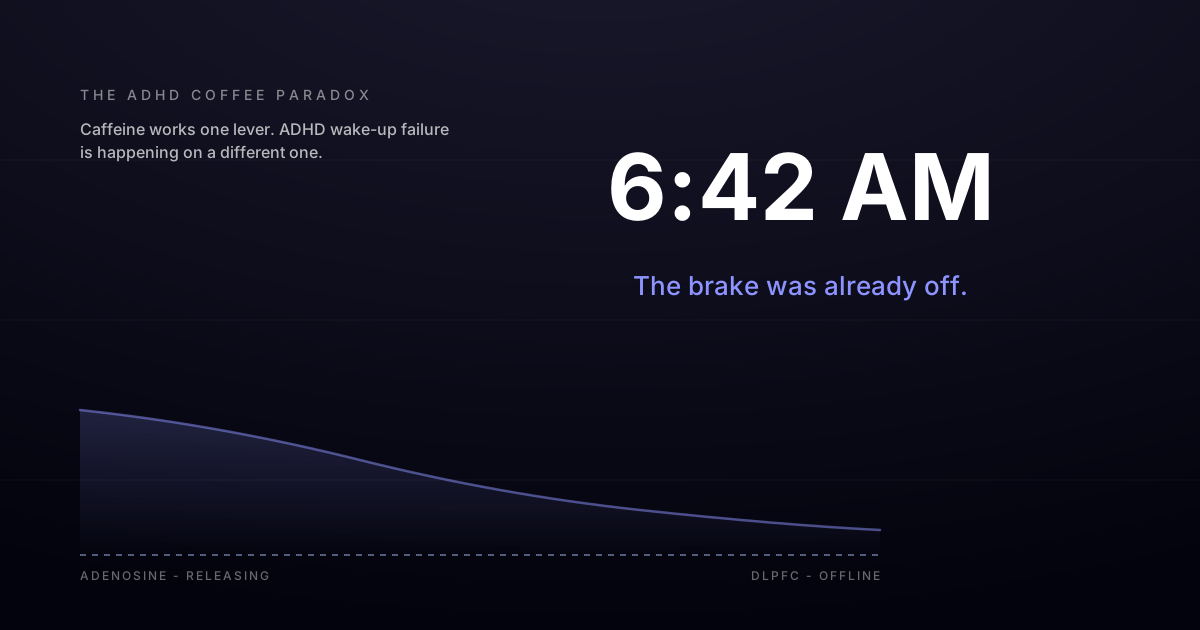
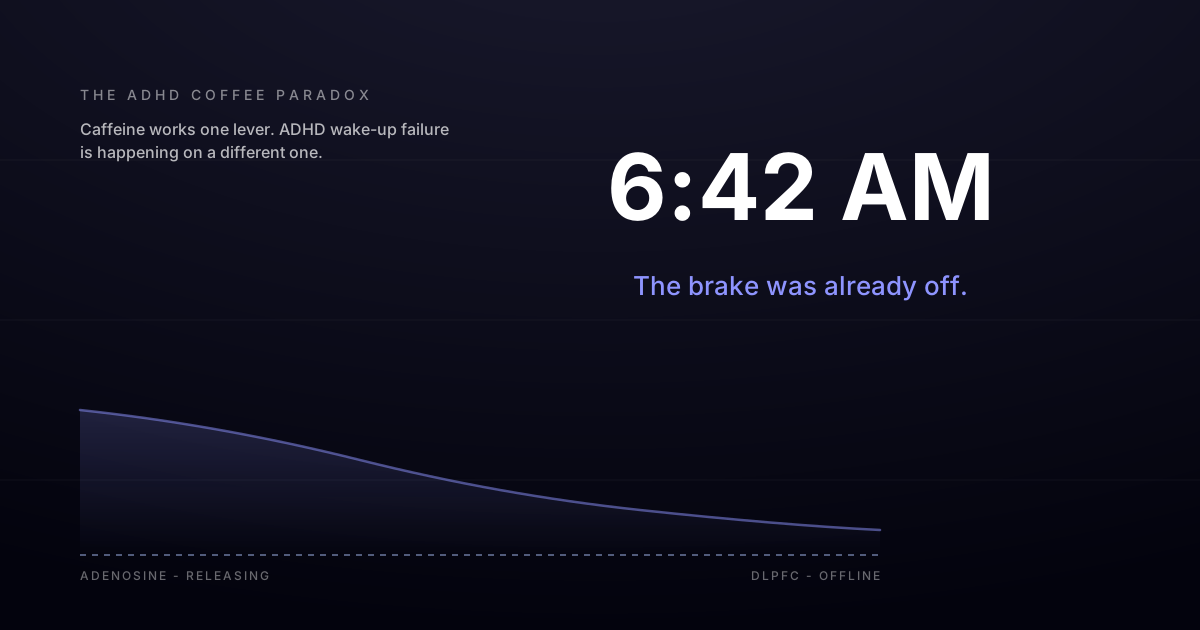
The mug was on my nightstand. I'd loaded the coffee the night before like a responsible adult. Alarm at 6:30. Sip by 6:32. Awake-awake by 6:45, that was the plan. 6:42 came and went. So did 7:05. I was still sitting on the edge of the bed, holding a cold cup, fully convinced I was the only person on earth for whom coffee was a scam.
I wasn't.
Caffeine works on one lever. ADHD wake-up failure is happening on a different lever. The cup on the nightstand isn't broken. It's wired to the wrong socket.
If you have ADHD and you've ever done the cup-pre-loaded-on-the-nightstand routine, you've probably had this morning more than once. You drink. You wait. Nothing happens. Or worse, you get sleepier. There are a thousand articles online about "the ADHD coffee paradox," and most of them list five or six contributing factors and refuse to name a primary one. This post names one. The mechanism is real. It has a name. And once you see it, you stop being surprised that the cup doesn't move you.
In this post, you'll learn:
- What caffeine actually does in the brain, on the receptor level, and why that lever exists at all
- Why ADHD wake-up failure isn't an adenosine problem and so caffeine targets the wrong axis
- The neural axis that is offline at the alarm, and the one mechanism that actually recruits it on the spot
7 min read
What caffeine actually does (and why it's a narrow lever)
Caffeine has one primary mechanism. It binds to adenosine receptors, mainly A1 and A2A, and blocks them. Adenosine is the brain's sleep-pressure signal. The longer you're awake, the more adenosine accumulates, the heavier sleep feels by 11 PM. When caffeine sits on those receptors, adenosine can't dock, and the sleep-pressure brake gets released for a few hours. That's the whole party trick. Fredholm and colleagues laid this out in painful pharmacological detail back in 1999 (Pharmacological Reviews 51(1), still the canonical paper).
There's a secondary effect. The same A2A receptors that adenosine sits on are heteromers with dopamine D2 receptors, which means blocking adenosine lets D2 signaling come up a little (Ferré, Journal of Neurochemistry 2008). That's where most of caffeine's "boost" feeling comes from in neurotypical brains. Tiny, indirect, downstream of the adenosine block.
So caffeine is a brake-releaser. It tells the brain the pressure signal isn't real anymore, you can be more awake than your sleep debt says you should be. It is genuinely useful at 2 PM when adenosine has built up and you'd otherwise crash through a meeting.
Here's the question nobody asks: at 6:42 AM, right after a normal night, is adenosine pressure the thing keeping the ADHD brain in bed?
No. It really isn't.
Why ADHD wake-up failure isn't an adenosine problem
Sleep inertia, the 15-to-30-minute window right after waking when executive function is degraded, doesn't run on adenosine. It runs on the slow recovery of large-scale brain networks, especially the prefrontal cortex. Tassi & Muzet 2000 (PMID 12531174) characterized this two decades ago. Hilditch & McHill 2019 (PMC6710480) followed up with the modern review. The pattern is consistent across labs: motor regions reboot fast, brainstem is fine the second you crack an eye open, and the dorsolateral prefrontal cortex (DLPFC), the part you need to do anything that requires deciding, comes up last and slow.
Vallat et al. 2018 (PMID 30223060) put people in an fMRI right after waking and watched the brain transition from the default-mode network (DMN) to the task-positive network (TPN). The default-mode side dominated for the first 15-ish minutes. The DLPFC, the action-deciding region, wasn't just quiet. It was running the wrong program.
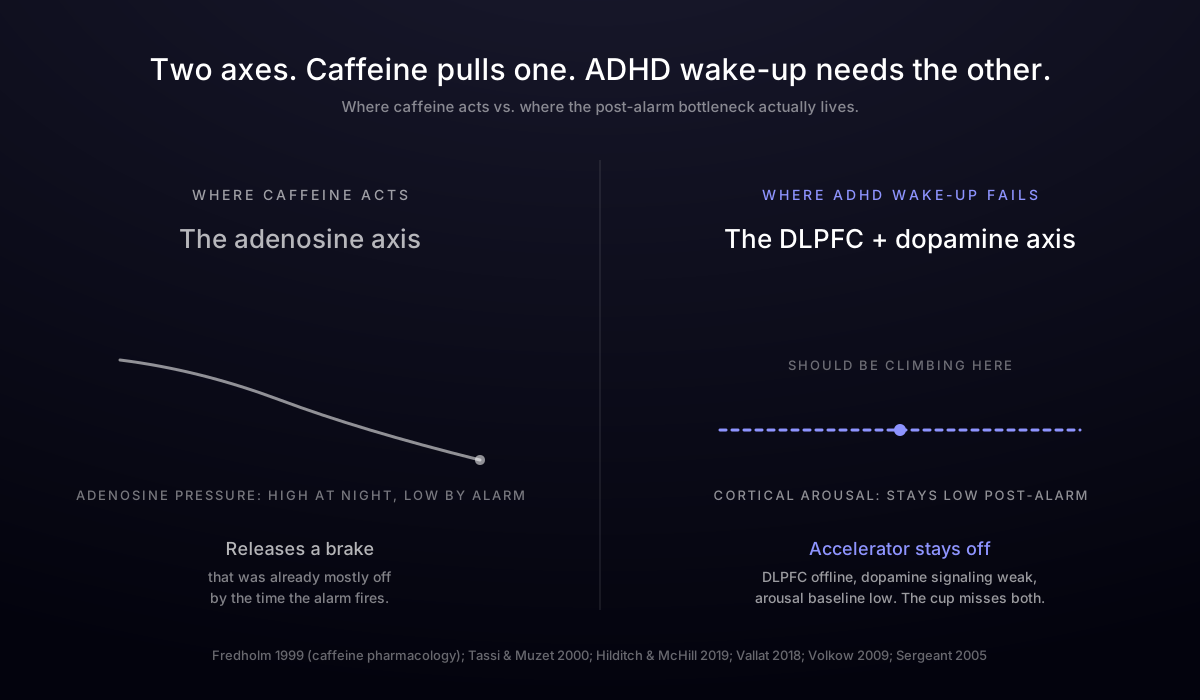
None of this is an adenosine story. Adenosine is mostly cleared in the first half of the night. By the time the alarm fires, the pressure signal isn't what's holding you down. You're not in bed because the brake is on. You're in bed because the accelerator isn't online yet.
For ADHD adults, the accelerator situation is worse. The cortical-arousal baseline runs lower. Sergeant 2005 (Biological Psychiatry 57) formalized this as the cognitive-energetic model: ADHD as a state-regulation deficit, not a knowledge deficit. The brain can run the program. It just can't reliably crank itself into the energy state where the program runs. Stacked on top of that is tonic dopamine deficit (Volkow et al. 2009, JAMA 302(10)), which is the reason stimulant medication works in the first place. Dopamine is the start signal. ADHD brains are chronically short on it. Mornings are the worst time of day for the shortage.
So at 6:42 AM, in an ADHD brain, the bottleneck looks like this: DLPFC offline, dopamine signaling weak, cortical arousal low, DMN running the show. The brake (adenosine) is mostly off already. The accelerator (DLPFC + dopamine + arousal) is the thing that isn't online.
Caffeine pulls the brake off harder. The accelerator is still on the floor.
That's the wrong axis.
The first time I noticed the cup wasn't doing anything
Years before any of this was a product idea, I had a stretch of mornings where I'd drink the pre-loaded coffee, sit there for forty minutes, and produce nothing. Not tiredness exactly. Not sleepiness either. A kind of empty alertness. Heart rate slightly up, eyes open, brain refusing to start a sentence. I thought I was caffeine-tolerant. I switched to cold brew, then to espresso, then to a thing called yerba mate I was convinced was an upgrade. Same morning. Same forty minutes of edge-of-bed nothing.
What broke the pattern, the one time it broke, was a phone call from my dad. The phone rang. I picked up. I talked. I noticed, hanging up, that I was now actually online. Not "caffeinated." Online. Cortex fully booted. The cup hadn't done it. The conversation had.
I told myself for years it was the adrenaline of the call. I now think it was something simpler. I'd been forced to generate language out loud. That recruits a specific circuit. That circuit was the offline one.
The right axis: language generation pulls the DLPFC online
Speech production is one of the most DLPFC-heavy tasks the brain runs. Generating a sentence out loud, even a boring one, recruits Broca's area, left DLPFC, and the motor speech regions all together (Indefrey & Levelt 2004, Cognition 92; Hickok & Poeppel 2007, Nature Reviews Neuroscience 8). The left DLPFC is exactly the region that's offline during sleep inertia. Talking is, mechanically, a boot signal for the editor. Not a workaround. A boot.
There's a second piece. The generation effect (Slamecka & Graf 1978, Journal of Experimental Psychology 4(6)) is the finding that information your brain produces is acted on more strongly than information it reads. Reading the post-it on the mirror that says "go to the gym" is a recognition task. Saying out loud "I am getting up, I am putting the left sock on" is a generation task. Different network load, different wake-up signal, different downstream behavior.
Kross et al. 2014 (Journal of Personality and Social Psychology 106(2)) added a third move: self-distanced self-talk (using your own name, second person) recruits prefrontal cognitive control more than first-person self-talk does. "Kuba, get up, the coffee already worked or it didn't, doesn't matter" hits harder than "I should get up." The grammar choice changes which network shoulders the load.
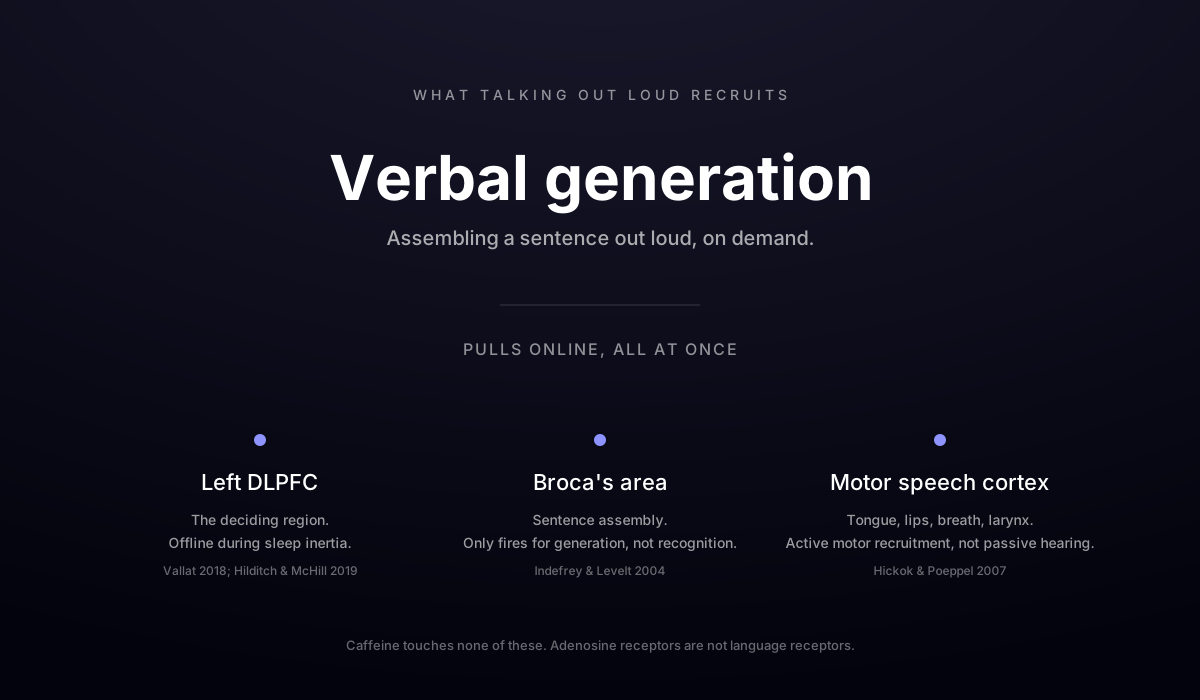
This is the axis caffeine doesn't touch. Adenosine receptors aren't language receptors. Blocking adenosine doesn't pull the DLPFC online. It just makes it slightly easier for the DLPFC to come online if something else is recruiting it. On its own, with nothing to talk to, the cup is a mild heart-rate intervention.
This connects to the same wiring I wrote about in your 5 AM brain is a world-class excuse generator. The DMN authors the excuse fluently. The DLPFC that would catch it isn't online. Caffeine doesn't change which network is loud. Talking does.
It also explains the pattern from your body wakes at 6, your brain wakes at 7:30. Heart-rate signals (coffee, cold shower, loud alarm) move the body up. Cortex-level engagement (a sentence you have to assemble out loud) is what moves the brain up. The cup is a body intervention. The mismatch isn't a discipline problem. It's a signal-routing problem.
What about Adderall, Vyvanse, the actual stimulants
This is the obvious objection. If the problem is tonic dopamine deficit, prescription stimulants should fix it. They do. They're the cleanest fix that exists for the morning, and the pre-dose alarm routine, where you keep the pill on the nightstand and take it 30-45 minutes before you actually need to be up, is the dominant strategy on r/ADHD for a reason. It works because it hits the right axis.
The trouble is the gap. Even with the pill swallowed at 6:30, you've got 30-plus minutes before pharmacokinetics get you to therapeutic levels. Those 30 minutes are the window where you either get up or you don't. The pill is loading. The coffee is bouncing around your adenosine receptors. Neither is talking to your DLPFC. Whatever bridges those 30 minutes determines what kind of morning you're about to have.
For most ADHD adults, what bridges those 30 minutes is the phone. Scroll, swipe, doom, half an hour later the meds are kicking in and you're already 40 minutes behind. The phone scroll is just the system the brain reaches for when nothing else is generating language to it.
What I actually built
That phone call moment, years before any of this was a product, was the thing I kept circling back to. Not the adrenaline of the call. The structure of it. A specific person was waiting on the other end. They asked a question. I had to assemble a sentence. The assembly was what booted the editor.
So I built a version of that into the alarm. The alarm fires, an LLM answers it, you have to actually answer back in words to make it stop. It's not a puzzle. It's not a math problem. It's a conversation that won't end until your DLPFC has been hauling language for maybe sixty seconds. The bet is mechanical, not motivational: forced verbal generation pulls the offline axis online faster than caffeine does, because it's recruiting the actual offline region instead of releasing a brake that wasn't holding you back in the first place.
That's what Stoke is. The cup on the nightstand for the right axis.
Closing
If your coffee at the alarm has been doing nothing for years, you're not broken, you're not undercaffeinated, and you don't need to switch beans. You're using a mechanism that targets adenosine in a brain whose problem isn't adenosine. The brake isn't on. The accelerator is off.
Keep the cup if you like it. Move it to mid-morning where the adenosine math actually checks out. For the alarm specifically, the lever that wants to be pulled is verbal. Say what you're about to do out loud, in the second person, before the lawyer in your head gets a sentence in. Or set Stoke for tomorrow morning and let it run the conversation that pulls the DLPFC online. I'd love to know if it lands.