Your ADHD Brain Decided the Alarm Wasn't New Before You Were Conscious
The reason ADHD adults stop hearing their alarms isn't habituation alone, it's a pre-attentive auditory filter (mismatch negativity) that runs at 200ms post-stimulus and is reliably smaller in ADHD brains. Here's why louder doesn't fix it and conversation slips around it.
May 16, 2026 · Updated May 24, 2026
Your ADHD Brain Decided the Alarm Wasn't New Before You Were Conscious
The pre-attentive filter under habituation, and why language slips around it.
I once slept through an alarm I had explicitly set the night before with the volume slider all the way up, the phone face-down on a metal lamp base for resonance, and a sticky note on it that said WAKE UP. Slept right through it. My partner came in at 7:50 and asked if I was okay.
I wasn't deaf. The alarm was loud. The recording shows my eyelids flickered.
My brain had filed the sound as "old" about a fifth of a second after each beep. Nine minutes of "old" sounds doesn't wake anyone up.
The thing I want to walk you through in this post is a layer underneath the habituation story everyone else writes. Habituation is real. I've written about it. But it's a post-attentive process, which is a fancy way of saying it happens after your brain decides whether something deserves your attention in the first place. Underneath habituation is a faster, dumber filter that runs in the first 200 milliseconds after a sound hits your ear. That filter decides if a sound is new. And in ADHD adults, that filter is set tighter than in everyone else.
In this post, you'll learn:
- What the mismatch negativity (MMN) actually is and why it's the filter under your alarm
- Why the MMN is reliably smaller in ADHD adults, on every replication
- Why language slips around the filter the way a tone never can
8 min read
The 200ms filter under everything
The way your brain handles sound is layered. The bottom layer is purely automatic, runs without you, and decides one thing: is this a new sound, or is this the same sound that's been there? The neuroscience term for the signal this layer generates is the mismatch negativity, usually shortened to MMN. It's an ERP, which is an event-related potential, which is just brain electricity measured on the scalp around 150 to 200 milliseconds after a sound arrives. Näätänen and colleagues laid out the canonical version of this in their 2007 review (Clinical Neurophysiology 118).
Here's the part nobody tells you. The MMN fires whether you're paying attention or not. It fires when you're asleep. It fires when you're focused on something else entirely. Its job is to flag change in the auditory stream so the rest of your brain can decide whether to allocate attention. If the MMN doesn't fire, the rest of your brain never gets the memo.
Think about that for a second. Before you have a chance to consciously notice your alarm, a little electrical wave somewhere over your temporal lobe has already decided whether the alarm counts as something to look at. If the answer is no, the alarm doesn't get escalated. It stays in the background, like the hum of a fridge.
Your conscious mind has no veto on this. By the time the question "did I hear my alarm?" reaches you, the filter has already cast its vote.
Why your filter is smaller
This is where the ADHD literature gets interesting, and where I think most "why can't I wake up" articles miss the level of analysis entirely.
Kemner and colleagues in 1996 (Biological Psychiatry 40) were one of the early groups to notice that children with ADHD show reduced MMN amplitudes compared to controls. Subsequent replications kept finding the same pattern, in children and in adults. The most useful modern reference is Yamamuro et al. 2021 in Translational Psychiatry (Nature; PMC8449778), who used MMN amplitude in drug-naive adult ADHD patients well enough that a machine-learning classifier could separate them from controls on the basis of pre-attentive auditory processing alone. The amplitude was smaller. The latency was longer. The signal was real enough to diagnose with.
A 2025 Cureus paper from Hsu, Cheng and colleagues (Cureus article) sibling-controlled the comparison and found the same gap. Smaller MMN, delayed P300, reduced pre-attentive auditory change-detection. Across two decades and a dozen labs, the finding has held.
The plain-English translation: your auto-detector for new sound runs quieter than a neurotypical person's. The filter that flags "hey, something changed, you might want to look" is fainter from the start, before any of your conscious effort or motivation gets a turn. It's not that you're ignoring the alarm. It's that the part of your brain whose job it is to flag the alarm to the rest of you isn't getting through with as much voltage.
Stack this on top of the normal habituation curve everyone has, the alarm goes from new to familiar over about a week, which I wrote about in why every alarm stops working after about seven days, and what you get is an ADHD brain that started with a fainter "new sound" signal and then dampens it from there.
By day three, the alarm is barely a blip in the pre-attentive layer. By day six, the blip is gone.
What it actually feels like
For a long time I assumed the way I'd "sleep through" an alarm was that my brain was choosing, at some level, to stay asleep. The phrasing people use on r/ADHD is the same: my brain decides the alarm isn't important, my body just dismisses it before I'm aware, I have no memory of turning it off. The framing is agentic, as if there's a tiny version of you in there making the call.
There isn't. There's a 200-millisecond electrical wave with a smaller-than-average amplitude that didn't fire loud enough to escalate the signal, so no decision was made because there was no decider. The filter just didn't ring the bell. Everything downstream, including the part of you that would have woken up and dismissed the alarm consciously, never got the memo in the first place.
This is also why the "phone across the room" trick stops working after the first week. The phone is still across the room, the room is the same volume, the alarm is the same alarm, but none of that matters because the bottleneck was never the volume reaching your ear, it was the MMN amplitude flagging the change after the sound had already arrived. Volume cannot fix the size of the wave that detects volume change. After a few mornings, the change is no longer change, and the detector goes quiet.
Why the conversation isn't on the same axis
Here's the part that took me a while to see, and it's the reason I built what I built instead of one more loud-alarm app.
Pre-attentive auditory change detection isn't the only signal pathway your brain has. It's the bottom layer, the one that runs without consciousness. There's another layer that requires consciousness to engage at all. Language is in the second category.
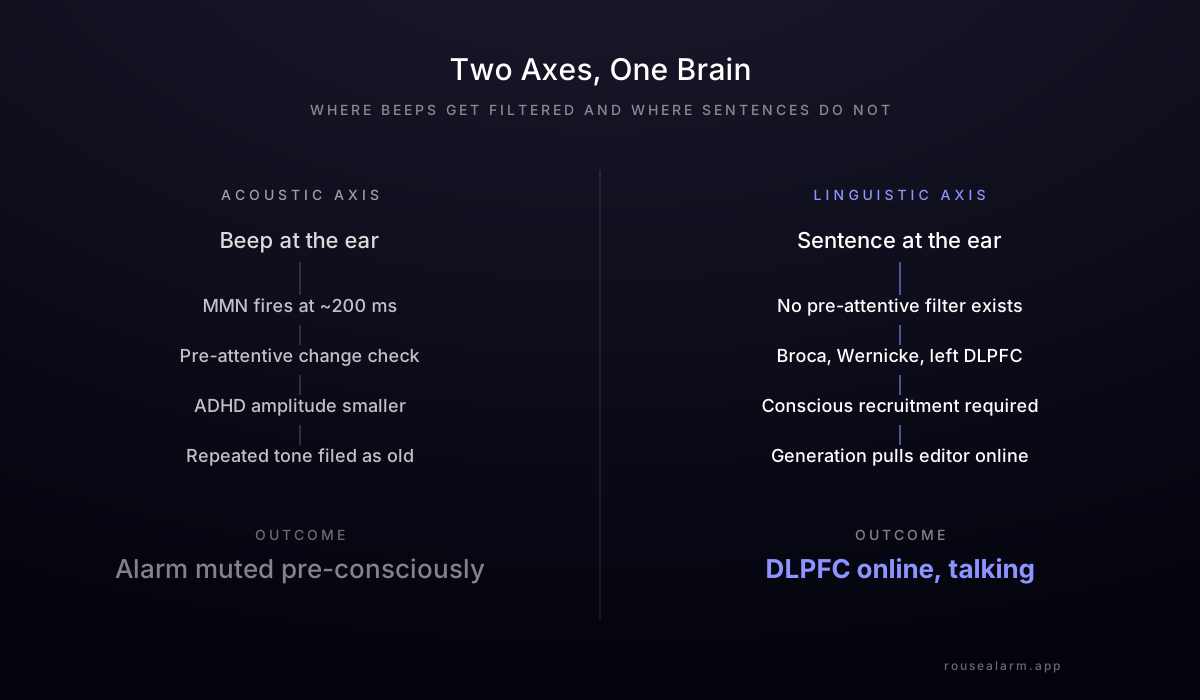
When a sound hits your ear, the MMN runs. When a sentence hits your ear, the MMN does almost nothing useful, because a sentence is not an acoustic event the way a beep is. Decoding language recruits Broca's area, Wernicke's area, and the left dorsolateral prefrontal cortex (Hickok & Poeppel 2007, Nature Reviews Neuroscience 8; Indefrey & Levelt 2004, Cognition 92). Those regions are conscious, top-down, and they have to be actively recruited to do the work, and there is no pre-attentive shortcut that "filters out" speech the way the MMN filters out a repeated tone, because speech is not the kind of stimulus the MMN evolved to handle.
A talking alarm cannot be muted by the same pre-attentive filter that muted the beep, because the brain machinery for that kind of muting is not there. You can absolutely ignore a voice if you are awake enough to ignore it, but ignoring it is an attention-allocation choice made in conscious regions, and there is no automatic 200-millisecond decision that takes it off the table before consciousness gets a vote.
That is the axis flip. Beeping alarms live or die at the MMN, and verbal alarms live or die at the DLPFC. The first axis is where ADHD is already at a disadvantage from the start, and the second is the one where ADHD adults function genuinely well once forced verbal generation gets the editor online, which I wrote about in the coffee paradox and in your body wakes at 6, your brain wakes at 7:30. The cup and the noise hit the wrong layer. The conversation hits the layer where ADHD has executive function to spare, once it is recruited.
What I actually built
The whole reason Stoke exists is that I kept running into this layer of the problem and not seeing it named anywhere in the consumer-facing material I was reading. I had every alarm a heavy sleeper can own: the Sonic Bomb, the Clocky that runs across the floor, the sunrise clock my partner bought me for Christmas, a vibrating pillow that cost more than I want to remember. Each one worked for about a week. Each one then got filtered into the room.
What didn't get filtered, in my own experience, was a phone call. The phone rang, I picked up, I had to assemble a sentence, and the sentence assembly bypassed every part of the auditory layer where the filtering happens, because language doesn't live on the auditory layer in that way. It lives on the conscious layer, and the conscious layer cannot pre-attentively mute itself.
So I built the phone call into the alarm. The alarm fires, an LLM picks up, and you have to actually answer back in words to make it stop. It's not a math puzzle, it's not a CAPTCHA, it's a conversation in which the act of speaking pulls the part of your brain online that doesn't have a smaller-than-average pre-attentive filter sitting on top of it. The bet is mechanical: route the wake-up signal through the layer where ADHD doesn't lose the first 200 milliseconds.
The MMN-and-ADHD work has been done on tones, not on alarm contexts, and as far as I can tell nobody has directly tested whether conversational input bypasses the MMN filtering ADHD adults show on repeated alarm tones. The mechanism predicts it should. I run it on myself every morning, and the answer for me is yes. Whether it lands the same way for you is something you would have to try.
Closing
If you've burned through five alarm apps in five months and the pattern keeps repeating, the missing piece may not be louder, harder, or smarter. It may be a different layer of the brain entirely. The acoustic layer has a small filter on it that you can't will yourself past. The linguistic layer doesn't have that filter, because the filter never evolved to handle that kind of input.
If you want to test the axis flip, set Stoke for tomorrow morning. Say one full sentence out loud before the snooze button has a chance to be a topic. See whether the first sixty seconds feel different. I'd love to know if it lands.