Your Whoop Score Decided You Were Skipping the Gym Before You Did
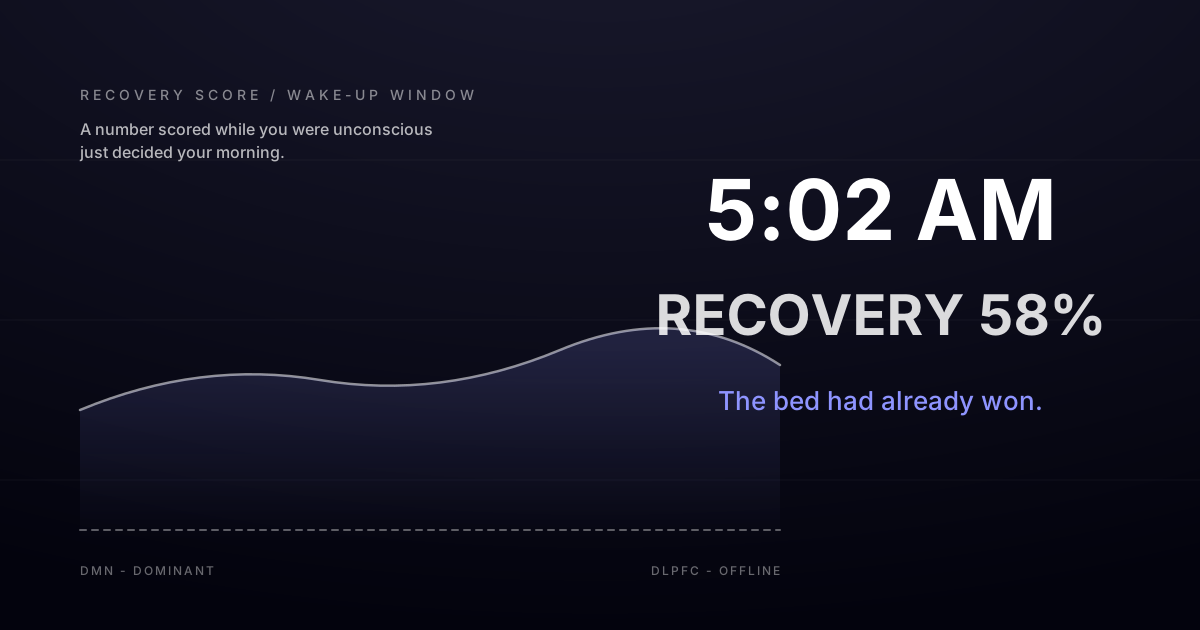
A yellow WHOOP score lands at 5:02 AM with the prefrontal cortex still offline. The wearable wins every argument the brain isn't online to have. Here's why a sound alarm can't push back and what does.
May 17, 2026 · Updated May 24, 2026
Your Whoop Score Decided You Were Skipping the Gym Before You Did
Why a number scored while you were unconscious wins every 5 AM argument it shouldn't be in.
The phone was face-up on the nightstand. I opened it before I sat up, before my left foot had even hit the floor, the way I do every morning whether I mean to or not. Yellow recovery. 58%. The watch had measured my HRV and respiratory rate while I was asleep, run the numbers, and printed a verdict.
I went back to sleep for forty minutes. I did not think about it.
A number that was generated while I was unconscious had just decided what I was doing that morning, and I never noticed the decision happen.
The thing I want to walk through is not whether recovery scores are accurate. Some of them are. The thing I want to walk through is what a recovery score does to your decision in the 30-second window between the alarm and standing up. That window runs on a different brain than the one that bought the wearable. The part that would normally interrogate a number, weigh it, decide whether to take the workout anyway, that part is not in the room yet.
The OP of a 2026 r/whoop thread put it cleaner than I could:
"Maybe I'm overthinking this, but I've noticed my WHOOP score kind of sets my mood for the workout before I even start. Yellow recovery and I'm already mentally preparing excuses. Green then I feel invincible even if my legs are actually cooked. Part of me wonders if I'd train better just... not looking at it until after."
The OP is naming the mechanism herself. Most people in the comments are arguing about whether WHOOP is right. That is the wrong axis.
In this post, you'll learn:
- Why the sleep-inertia window leaves the prefrontal cortex offline for 15-to-30 minutes, and why that's the exact window the recovery score gets read
- Why a number labeled "your recovery" is processed as authoritative judgment by a brain that has no editor online to challenge it
- Why a sound alarm can't argue with a yellow score, and which specific neural circuit a conversation pulls online instead
8 min read
The window the score arrives in is not a normal decision window
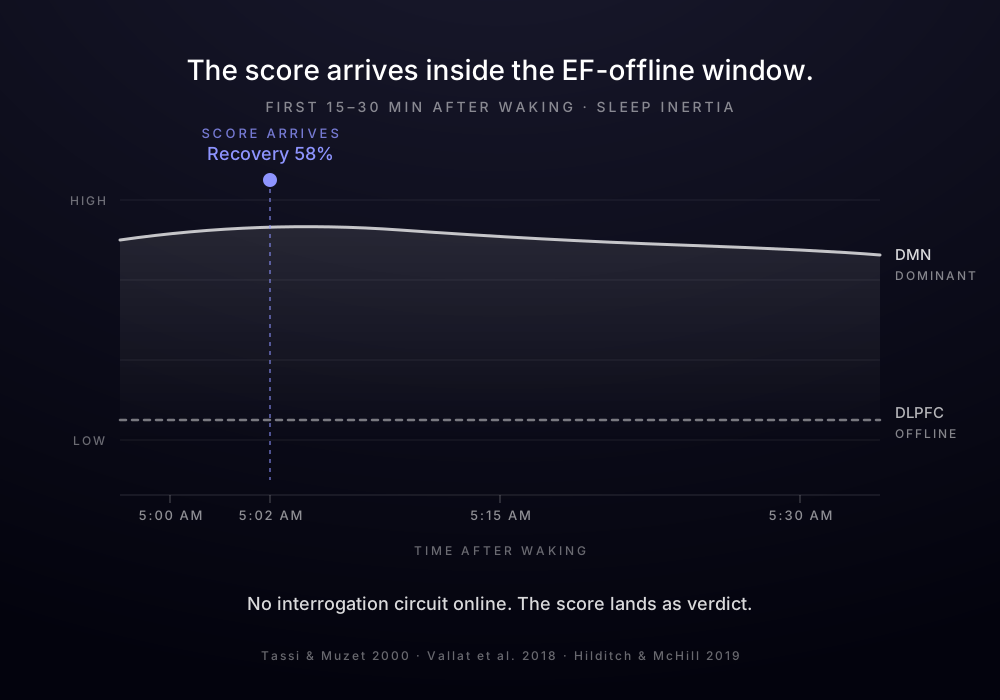
Sleep inertia is the 15-to-30-minute period after waking when executive function is degraded. Canonical characterization in Tassi & Muzet 2000 (PMID 12531174); modern review in Hilditch & McHill 2019 (PMC6710480). Motor regions reboot fast. The brainstem is fine the second you crack an eye open. The dorsolateral prefrontal cortex (DLPFC), the part you'd need to look at a number and decide whether it should change your plan, comes back last and slow.
Vallat et al. 2018 (PMID 30223060) put people in an fMRI scanner right after they woke up and showed the default-mode network (DMN) running while the task-positive network stayed suppressed. The DLPFC wasn't just quiet. It was running the wrong program. The brain online in those first 15 minutes is the autobiographical-narrative brain, the one that produces inner monologue and counterfactual stories, not the one that does evidence-weighing.
Now drop a number into that window. A number pre-labeled "your recovery," produced by a sensor on your wrist that ran while you were asleep, packaged with a color, framed inside an app you pay a monthly fee to listen to. The framing is doing most of the work before the digit even loads.
In normal life, when you see a number you don't immediately understand, your prefrontal cortex interrogates it. Where did this come from. What does it actually measure. Does it match what I feel. That interrogation is the basic move that prevents you from treating every numerical input as gospel. At 5:02 AM, the interrogation does not happen. The score-evaluating brain is structurally not invited to the meeting where the score is being evaluated.
A number in the wake-up window is read as authoritative judgment, not data
Three biases stack on top of the offline-DLPFC story, and together they make a 58% land harder than it should.
Tversky & Kahneman 1974 (Science 185(4157)): when a number is presented first, subsequent judgments cluster around it, even when the number is arbitrary and the subject knows it's arbitrary. Anchors get stickier under cognitive depletion. That is exactly the state every wearable user is in when they read the morning score.
Cialdini's authority heuristic from Influence: numbers feel more authoritative than words. A wearable score has a clinical aesthetic, a percentage, a color band. It looks like evidence and it is read like evidence. The reading doesn't pause to ask which study validated the formula. It just registers somebody scientific decided I am at 58%.
Kunda 1990 (Psychological Bulletin 108(3)): motivated reasoning, the tendency to construct beliefs that serve a goal, gets more aggressive under cognitive depletion. The 5 AM brain isn't a worse reasoner. It's a more motivated one. And the goal it has, almost universally, is to stay in bed. A 58% recovery is not a number anymore. It's a permission slip. The permission slip arrives in the one window where the brain that would have asked who issued this permission is offline.
The same yellow score at 7 PM would have meant almost nothing. You'd have glanced at it, shrugged, googled whether HRV is affected by alcohol, kept your dinner plans. The morning version of you got a one-line judgment from an oracle and rolled over.
A 417-upvote r/whoop thread titled "The secret? Don't exercise" opens:
"The secret? Don't exercise. Stopped working out a few days even though I had yellow or green recoveries (sleep is always good) and I get a peak."
The thread is sarcastic. The mechanism it's circling is not. Stop exercising, the score goes up. Start exercising, the score goes down. Train only when the score says you should and you only train when you haven't been training. The recovery score has a feedback loop with the exact behavior it's supposed to inform, and the loop tightens every time you defer to it.
Oura reads the same. In a 623-upvote r/ouraring thread titled "14 months in review and why I'm quitting the ring":
"Sometimes the ring tells me I'm 'optimally rested' after waking at 3am wide awake for an hour, then tells me a great 9.5-hour sleep was 'good.' I started questioning my own feelings against the numbers."
Questioning my own feelings against the numbers is the sentence I'd circle. There is no contest there unless the questioning happens in a brain that is actually online to do it, and at 5 AM that brain is not in the room.
The "just don't check it" advice is the right intuition pointed at the wrong infrastructure
The fix that gets upvoted hardest in those threads is some version of don't look at the score until after. Intuitively correct. From the same r/whoop thread:
"I train first thing in the morning and I never look at Whoop until afterwards. On race days I never open the app at all. It's go time regardless." (source)
"Treat yellow & green the same in regards to working out, i.e. workout as planned unless you're in the red or otherwise feel awful. Don't let yellow/green control you." (source)
These are reasonable rules. They require an EF-online brain to enforce them. The "don't check" intention was set by 10 PM you, who can absolutely refrain from opening an app. The hand that taps the screen at 5:02 is being driven by procedural memory, not by intention. By the time the rule "don't open WHOOP yet" surfaces, the score is already in the visual field.
Sheeran 2002 (European Review of Social Psychology 12(1)) showed that roughly half of stated intentions don't translate to behavior, and the gap widens at the moments when executive function is otherwise occupied. Waking up is the canonical such moment. The morning rule about phone-checking is running on the same offline CPU as the morning rule about getting out of bed.
Switching wearables doesn't fix it. WHOOP says rest, Garmin says train, Oura says optimally rested. The user becomes a meta-shopper for the oracle that gives them today's answer. The mechanism never changed. They just rotated the source of the permission slip. From a 256-upvote r/whoop thread:
"Had my longest recorded sleep in 262 days with Whoop yet I'm in the red... Whoop says to rest, Garmin says I should do some threshold training today. Kudos to Whoop for knowing my body more than I know myself."
I want to be careful here. I'm not saying the recovery score is wrong. Some of the underlying physiology is real. The post's bite is that even when the metric is right, handing it to a brain in EF-offline mode is the wrong moment to use it. The metric is a tool. The timing of the read is the bug.
The sound alarm can't argue with a number. A conversation can.
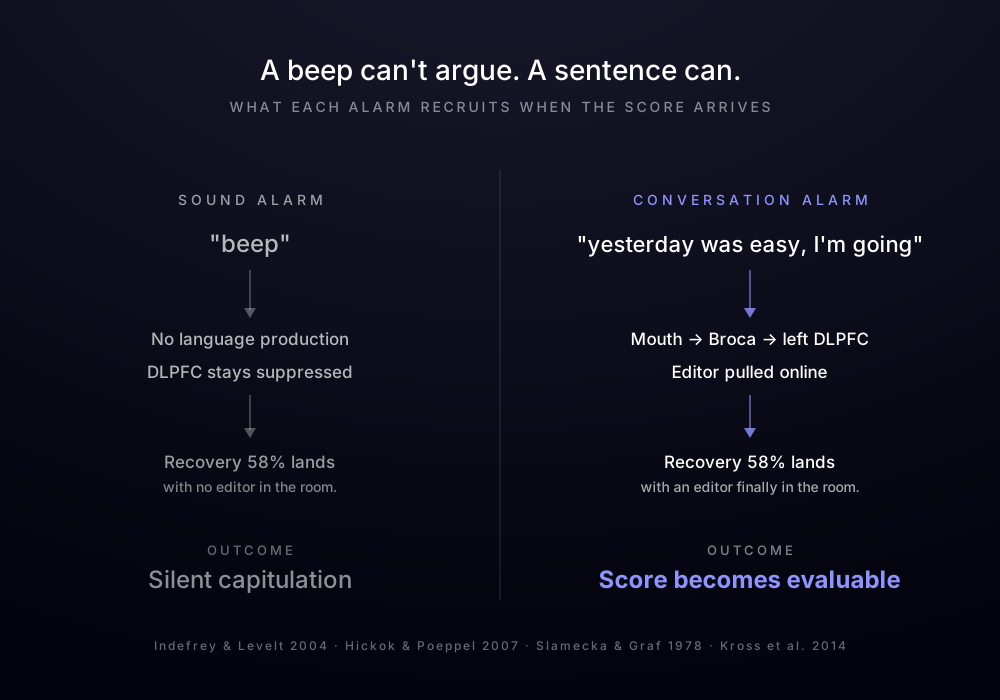
A sound alarm cannot challenge a recovery score. The beep does not say based on what HRV baseline. It does not say you trained late last night, of course the score is yellow. The beep can only get louder. The score has language and a model behind it. The beep has no language. In any argument between a worded judgment and a wordless noise, the worded judgment wins by walkover.
The recovery score writes the morning's narrative unopposed.
What does fight back, mechanically, is forced verbal generation. Speech production is one of the most DLPFC-heavy tasks the brain runs. Generating a sentence out loud, even a boring one, recruits Broca's area, the left DLPFC, and motor speech regions (Indefrey & Levelt 2004, Cognition 92, PMID 15037129; Hickok & Poeppel 2007, Nature Reviews Neuroscience 8, PMID 17431404). The left DLPFC is exactly the region suppressed during sleep inertia. Talking is not a workaround for the offline editor. Talking is the boot signal for the offline editor.
Add the generation effect (Slamecka & Graf 1978, Journal of Experimental Psychology 4(6)). Information your brain produces is acted on more strongly than information it reads. Reading "yellow recovery, 58%" is recognition. Saying out loud "yellow recovery, yesterday's session was easy, I'm doing the workout" is generation. Different network load. Different downstream behavior. Kross et al. 2014 (PMID 24467424) added that self-distanced self-talk, using your own name or the second person, recruits prefrontal cognitive control more than first-person self-talk does. The lawyer in your head writes in first person. The judge that catches the lawyer writes in second.
Put it together. A number arrives at 5:02 AM. The brain that would have asked it questions is offline. The only intervention that pulls that specific brain online faster than ambient time is forced language production. A sound alarm cannot force language production. A conversation does, mechanically, with no willpower required.
This is the same axis flip I wrote about in the coffee paradox at the alarm and in why your 5 AM brain is a world-class excuse generator. The score, the cup, and the excuses are all running on a brain whose evaluator is offline. None of them are fixable by giving the offline part a louder input. They are fixable by recruiting the offline part with the one stimulus it cannot ignore: speech it has to produce.
What I actually built
I had every alarm a heavy sleeper can own. I also had a Garmin and a WHOOP. The two devices, on a Tuesday, would routinely disagree about whether I should train. The brain that read those disagreements at 5 AM was the wrong brain. By the time the right brain came online, I'd usually already let one of the oracles decide.
So I built the conversation into the alarm. The alarm fires, an LLM picks up, and you have to actually answer back in words to make it stop. It is not a math puzzle. It is not a CAPTCHA. It is a conversation in which the act of speaking pulls online the part of your brain that would have interrogated the recovery score in the first place. By the time you check the WHOOP, you are checking it with the brain that bought the wearable, not the brain the score is hijacking.
The score doesn't go away. The yellow is still yellow. What changes is that the version of you reading the yellow has executive function back. You can still skip the workout. You just have to do it on purpose, in front of a judge, with a coherent argument. That is a fundamentally different decision than the one that happened in the silent gap between the alarm and the second pillow.
This generalizes, by the way. The scale, the calorie app, the sleep tracker, the mood app, anything that hands a numerical "objective" verdict to a brain that's still booting. The recovery score is the cleanest example because users pay monthly and treat it as gospel. The structural mechanism is the wake-up window itself.
Closing
If you've spent six months wearing a recovery score, skipping workouts on yellow days, getting the creeping sense that the wearable is making your morning decisions while you sleep, the missing piece is not a better wearable. It is a way to be online when the wearable speaks.
Set Stoke for tomorrow morning. Let it pull the editor up before you open WHOOP. See if the same yellow score feels different read by a brain that is actually awake to read it.
I'd love to know if it lands.
Related reading:
- You Spend 45 Minutes Negotiating a 35-Minute Run. Here's Why. (the Rubicon deliberation model that runs in the same 15-minute window)
- The Trade You Made When You Started Training: Deeper Sleep Bought With a Harder Wake-Up (why the fitness enthusiast wakes into a deeper sleep-inertia hole than the average user)
- You Laid Out Your Gym Clothes. You Walked Past Them. Here's What Friction Removal Can't Fix. (the companion mechanism: the Fogg-model lever that doesn't fire when EF is offline)
FAQ
Aren't recovery scores backed by real science? Some of the underlying physiology is real. HRV reflects autonomic balance. Sleep stages have measurable architecture. The composite "recovery score" is a model on top of those signals, and the model varies by vendor, year, and firmware update. The post isn't claiming the metric is wrong. It's claiming the wake-up window is the wrong moment to read it.
Why does the same yellow score not bother me at 7 PM? At 7 PM your DLPFC is online and your DMN is not running the show. You can ask the score questions. You can weigh it against how you actually feel, what you trained yesterday, whether you slept badly because of caffeine versus illness. The asking is what disarms the score. At 5 AM the asking does not happen, because the brain region that does the asking is the slowest region to come back online.
Wouldn't it be enough to just not check the app until after the workout? For people whose DLPFC boots fast, yes. For the rest, the hand finds the phone before the rule "don't check" has been remembered. Procedural memory drives the unlock at 5:02 AM. The rule lives in the brain region that won't be online for fifteen more minutes.
Does Stoke tell me whether to skip or not? No. Stoke doesn't read your wearable. The alarm fires, the conversation runs, your editor comes online faster than it would have otherwise. What you do with the recovery score after that is up to you, but you'll be doing it with a brain that can actually evaluate the number instead of a brain that defaults to whatever the number suggests.
References
- Bellenger, C. R., et al. 2023. Methodological considerations in the use of HRV-derived recovery scores. Sports Medicine - Open.
- Cialdini, R. B. 1984. Influence: The Psychology of Persuasion.
- Hickok, G., & Poeppel, D. 2007. The cortical organization of speech processing. Nature Reviews Neuroscience 8. PMID 17431404.
- Hilditch, C. J., & McHill, A. W. 2019. Sleep inertia: current insights. Nature and Science of Sleep 11. PMC6710480.
- Indefrey, P., & Levelt, W. J. M. 2004. The spatial and temporal signatures of word production components. Cognition 92. PMID 15037129.
- Kross, E., et al. 2014. Self-talk as a regulatory mechanism: how you do it matters. Journal of Personality and Social Psychology 106(2). PMID 24467424.
- Kunda, Z. 1990. The case for motivated reasoning. Psychological Bulletin 108(3).
- Sheeran, P. 2002. Intention-behavior relations: a conceptual and empirical review. European Review of Social Psychology 12(1).
- Slamecka, N. J., & Graf, P. 1978. The generation effect: delineation of a phenomenon. Journal of Experimental Psychology: Human Learning and Memory 4(6).
- Tassi, P., & Muzet, A. 2000. Sleep inertia. Sleep Medicine Reviews 4(4). PMID 12531174.
- Tversky, A., & Kahneman, D. 1974. Judgment under uncertainty: heuristics and biases. Science 185(4157).
- Vallat, R., et al. 2018. Hard to wake up? The cerebral correlates of sleep inertia assessed using combined behavioral, EEG and fMRI. NeuroImage. PMID 30223060.